Are sinkholes becoming a bigger risk than we think?
Peter Adesina warns that sinkholes are becoming more frequent, and ignoring them is costing us millions for The Conversation.
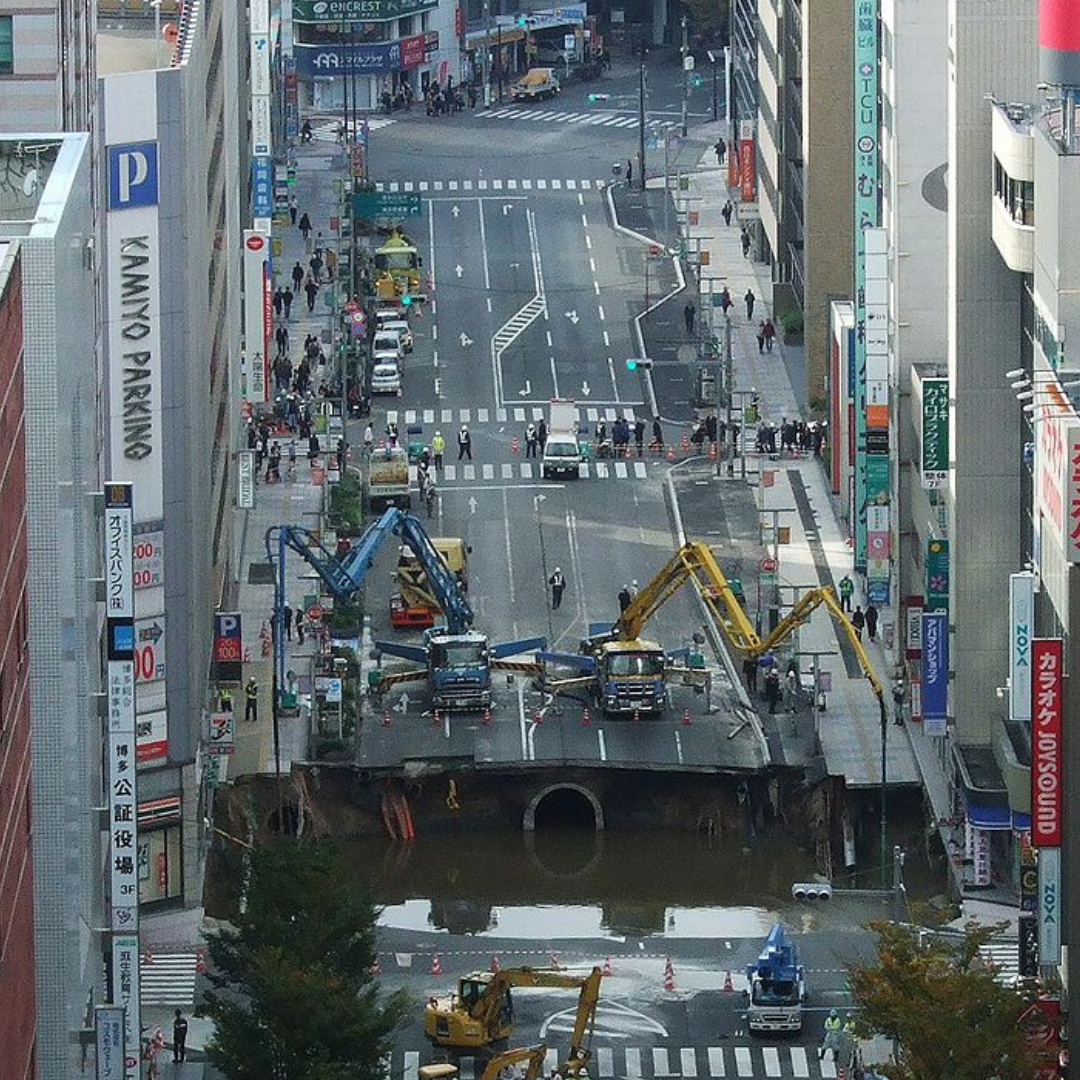
Image: A sinkhole on Hakataekimae avenue, Hakata City, Japan, on November 8, 2016 | Muyo | Wikimedia Commons
Peter Adesina is a postdoctoral fellow in geotechnical engineering at the University of Toronto, Canada.
You trust the road beneath your tyres. But, what if that trust is misplaced? Sinkholes are increasingly turning ordinary streets into danger zones. And the cost of ignoring them is skyrocketing.
Each year, sinkholes swallow roads, homes and businesses around the world, including in Canada, the United Kingdom, Kenya, South Africa and the United States.
They disrupt daily life, contaminate water supplies and cause significant damage to buildings and structures — often with devastating economic effect in economically disadvantaged regions. Repairs can cost hundreds of thousands to millions of dollars. With government budgets already stretched thin, it is critically important to prevent rather than fix sinkholes.
What causes sinkholes?
Sinkholes are sometimes mistaken for potholes, but they are far more dangerous.
Potholes are surface nuisances that form on the surface due to wear and tear and freeze-thaw cycles. Sinkholes, meanwhile, start deep underground. They form when water dissolves rocks such as limestone and gypsum or when underground soils are eroded by water, creating hidden cavities.
Leaks from damaged pipes or concentrated rainwater runoff can trigger this process, as seen recently in downtown Toronto, Canada.
These cavities grow silently until the surface collapses, sometimes swallowing entire streets. Human activities such as construction and mining, and natural events such as earthquakes, can accelerate their formation.
Loose, sandy soils and fast-moving water make the ground even more vulnerable. When collapse happens, the results can be catastrophic.
Extreme weather events, such as heavy rains, droughts and freeze-thaw cycles, put stress on underground pipes, making them susceptible to damage that releases water into the ground.
Climate change worsens this by lowering water tables during droughts, causing cracks in soils and weakening binding strength, making the ground weaker and more likely to collapse.
Ageing underground infrastructure compounds the problem: old pipes fail more easily, releasing water into the ground. Both climate change and ageing infrastructure can explain why sinkholes are appearing more frequently around the world.
Can we predict sinkholes?
To build resilience against sinkholes forming in the ground, it’s imperative to be able to predict sinkholes. A comprehensive understanding of soil properties in locations of importance is required to assess the potential for sinkhole formation and develop predictive models and early warning systems.
Surveys and geological inspections have been used to map the risk of sinkhole formation in the Canadian province of Nova Scotia, where sinkholes are prevalent.
Technologies such as satellite-based remote sensing and subsurface-deformation sensing techniques, for example distributed fibre optic sensing, can be used to identify existing underground cavities and decipher areas of low density where sinkholes could occur in the future.
Tools used to monitor water table level can also be useful to predict future sinkholes. Damage detection sensors installed in underground water infrastructure can provide early warnings before flows from water mains result in sinkholes.
Cities can act now to take steps to prevent sinkholes before they happen. Rainwater runoff should be redirected into existing natural water channels to avoid pooling in high-risk areas.
Loose soils can be compacted to make them more stable and, in large projects where a sinkhole could have huge economic implications, replacing weak material with stronger fill may be necessary.
Engineers can also reinforce soils with geosynthetics and seal underground drainage channels with grout or concrete to prevent erosion and sinkhole formation. These measures cost far less than repairing catastrophic damage.
A call to action
The cost of sinkholes to economic activities and property is enormous.
Sinkholes are not just costly inconveniences; they are a growing threat to commercial activities, livelihoods and property. With climate change, sinkholes are becoming more frequent and will worsen with huge implications for now and in the future.
Research is needed to understand the effects of extreme weather events on accelerated sinkhole formation so we can build sinkhole-resilient roads and infrastructure and avoid disasters that will happen if we fail to act.
Governments need to invest in the development of predictive tools and sinkhole prevention strategies by providing research funding and support for scalable technologies emanating from research on sinkholes. Supporting preventive measures will help minimise overall costs since prevention is a lot cheaper than repairs.
This piece was originally published by The Conversation and can be found here.