Why is Russia’s hybrid war against Europe intensifying?
Matt Ince looks at a new Dragonfly report, showing Russia’s hybrid operations are intensifying amid a fracturing transatlantic alliance.
Image by alexkich | Freepik
Predictable transatlantic security has ended. As US strategic interests shift, the foundations of European defence are fracturing, creating a leadership vacuum that weakens deterrence. This is not a temporary divergence, but rather a structural rupture from the post-Cold War order – one that creates a near-term window of vulnerability in Europe, with direct effects for businesses operating across the region.
This uncertainty increases the likelihood that Russia will intensify hybrid operations, also known as grey zone activities, to test NATO’s commitment to collective defence. Moscow increasingly uses such operations, including acts of sabotage, cyber attacks and disinformation, to sow discord and discredit European governments, raising immediate operational risks for companies reliant on secure supply chains, infrastructure and digital networks.
At the same time, Europe’s efforts to build a more sovereign security architecture are likely to lag behind Russia’s ability to remobilise. Several governments assess that Russia could regenerate sufficient conventional military capability to threaten NATO territory within two to five years after the war in Ukraine ends.
This is faster than European NATO members can field a military force capable of sustaining a prolonged confrontation without US support. Put simply, Europe is entering a critical period in which Moscow could probe NATO cohesion through limited incursions or coercive pressure with relative impunity.
An open window
This vulnerability is being amplified by growing divergence between US and European strategic priorities. Washington’s coercive bid to control Greenland, threats to impose punitive tariffs against NATO allies, and criticism of European reluctance to support operations against Iran signal a recalibration of US alliance policy.
While the US is likely to remain engaged in Europe, Washington seems intent on reducing its military footprint in the region and minimising operational commitments. Support for Ukraine is likely to be framed increasingly as Europe’s responsibility, with US contributions to European security presented as conditional on Europe’s defence spending and wider policy alignment with US interests. This dynamic risks undermining deterrence by injecting doubt into NATO’s resolve to act collectively in response to perceived threats against one or more of its members.
In this context, Russia is likely to remain the primary near-term security challenge to Europe and the principal beneficiary of transatlantic fragmentation. The most immediate risk is intensified hybrid activity aimed at exploiting political divisions within NATO and diverting resources away from Ukraine.
Dragonfly research, contained in a new report, Europe’s New Risk Map, highlights Moscow’s growing capacity to conduct disruptive grey zone activity at scale. The report, which draws on insights from the firm’s proprietary hybrid warfare dataset, documented 251 incidents in 2025 across 27 European countries, a more than 60 per cent year on year increase, following a near tripling between 2023 and 2024. Russia’s targets have expanded beyond defence to include transport, energy, telecommunications and water infrastructure.
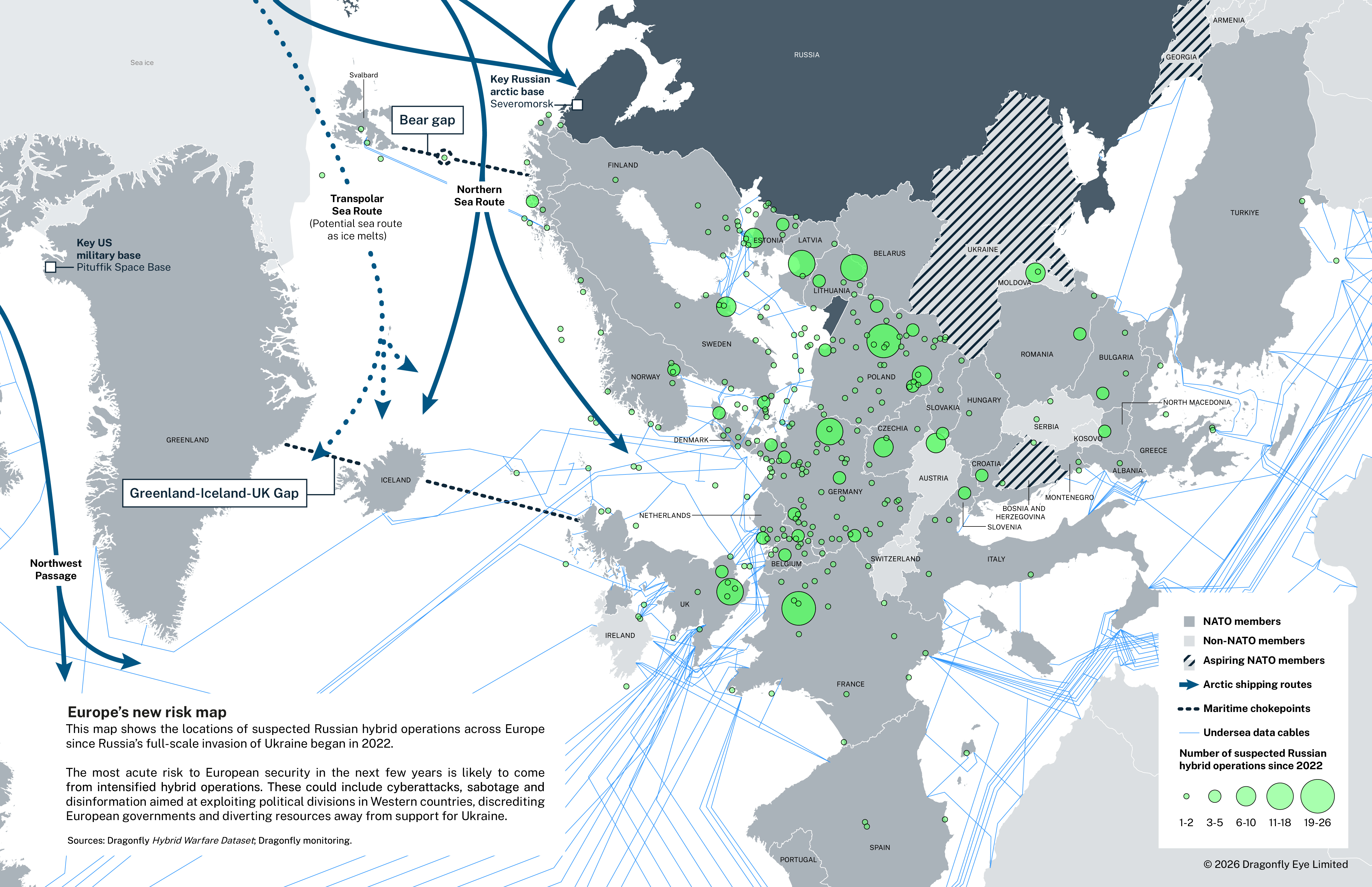
Image: Europe's New Risk Map | Dragonfly
Even more concerning for European policymakers and business leaders, is that this acceleration in hybrid activity may coincide with a period in which Russia also tests the boundaries of conventional escalation before a credible independent European deterrent is fully established.
Uncertainty around US commitments creates incentives for probing European defences and testing NATO’s commitment to the alliance’s Article 5 collective defence clause. A ceasefire in Ukraine during 2026, according to Dragonfly, would open a four-year window in which Russian military regeneration outpaces Europe’s ability to field an independent defence posture without US support.
The Kremlin’s failure to achieve decisive objectives against Kyiv, combined with domestic fragility, increases incentives for calibrated external escalation. The risk of conflict in Europe beyond Ukraine’s borders, while still low, is therefore at its highest level in decades.
The peak risk of a sustained conventional Russian campaign against NATO territory would probably emerge between 2028 and 2030. This window would narrow if the war continues beyond 2026 – as Russia would probably exhaust much of its recoverable legacy equipment and accumulated offensive strike stockpiles. Still, the near-term risk environment is likely to be defined by heightened exposure to both hybrid disruption and limited escalation.
Steering the ship
For businesses, the implication of all this is not imminent continent-wide war, but a sustained period of heightened political and operational volatility. Europe’s evolving security environment increases direct operational, financial and market-access risks, particularly in the Baltic and Nordic regions, where episodic crises are more likely to disrupt supply chains and investor confidence.
Hybrid attacks on critical infrastructure raise the likelihood of power outages, data disruption and logistics bottlenecks. Any escalation to open conflict on NATO’s eastern flank would have immediate consequences, such as airspace closures, restricted market access, disruption to Baltic shipping routes, asset exposure in frontline states, and heightened volatility in energy and commodities markets.
Organisations with significant European exposure should therefore embed forward-looking intelligence, scenario analysis and early warning indicators into decision-making and resilience planning. The ability to anticipate and absorb disruption, rather than simply react to it, will be critical to maintaining operational continuity and strategic advantage.
Matt Ince is the Associate Director for Geostrategic and Global Risks at Dragonfly, from Dow Jones.