CRJ 21:2 is live now!
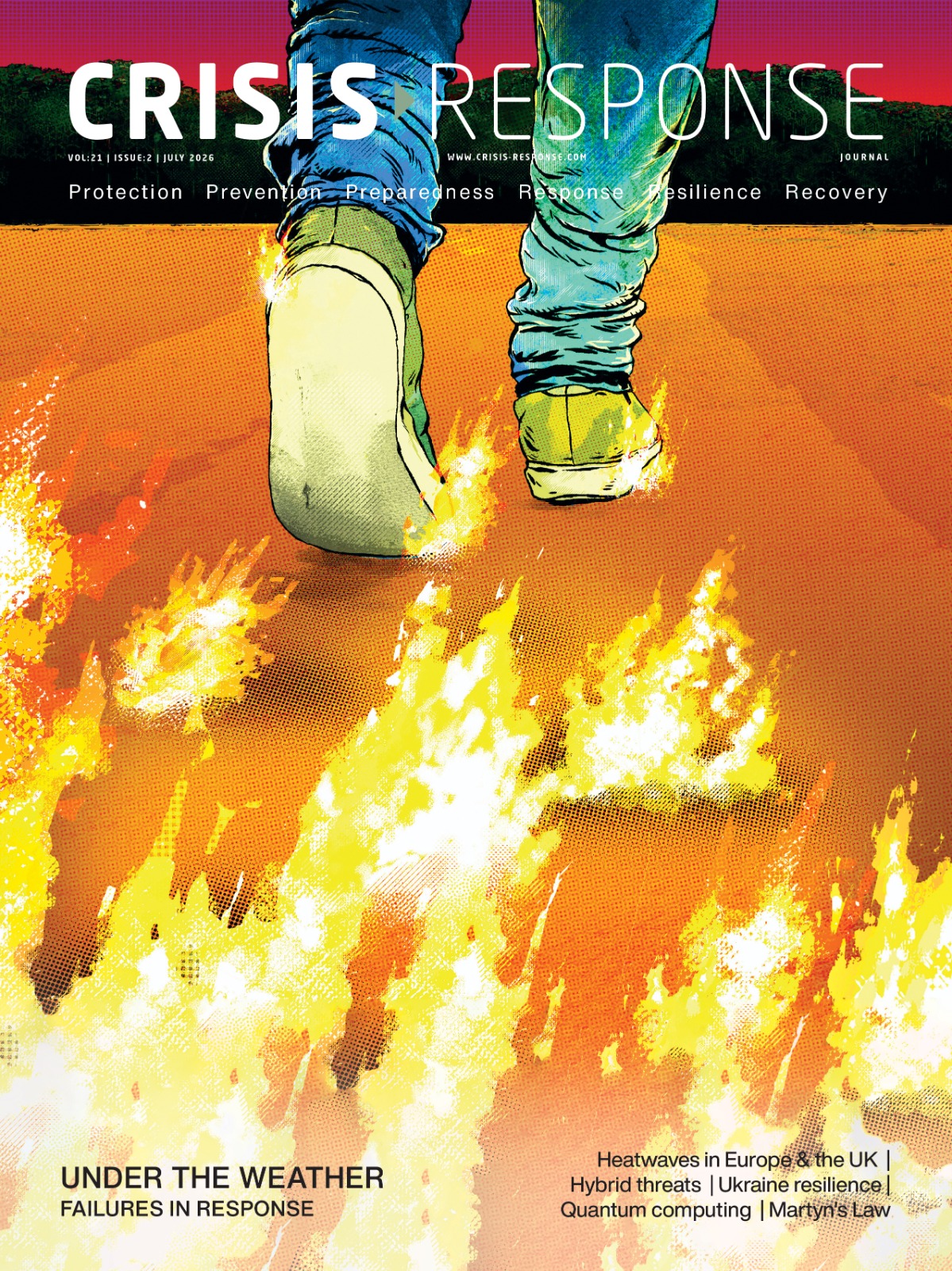 Our July 2026 issue is now live. The digital edition can be accessed here on the CRJ website, whereas CRJ 21:2 hard copies will be mailed out shortly.
This edition’s cover story is ‘Under the weather.’ Through a series of articles, our authors examine climate challenges across the UK and Europe, critical infrastructure and response systems under strain, and the growing challenge of crisis fatigue among responders and communities alike. The edition also explores community-level preparedness in an era of risk and hybrid warfare, approaches to strengthen organisational resilience, and moving beyond Martyn’s Law to adapt to security threats.
Comment: Eric McNulty highlights the often-overlooked value of business continuity and resilience as organisation-wide functions, while Matt Minshall argues that existing legal and cultural practices are making it harder for Europe and the UK to adapt to increasingly worsening heatwaves.
Under the weather: Cedrick Moriggi presents the escalating and interconnected environmental crisis as the greatest resilience challenge. He writes: “We can predict likelihood. We can model damage. We can prepare a response. What we cannot do is negotiate with tectonic plates, instruct a monsoon to moderate itself, or tell a firestorm to stop at a boundary we have drawn on a map.”
Jeannie Barr addresses the need to build a collaborative resilience approach to a changing climate, while Anna Karas examines the threat against critical infrastructure networks.
Focusing on response failures: Nikita Saran looks at how systems collapse, be they visible technology assets or the secondary human ones, and the role of leadership in identifying and mitigating the consequences of such failures.
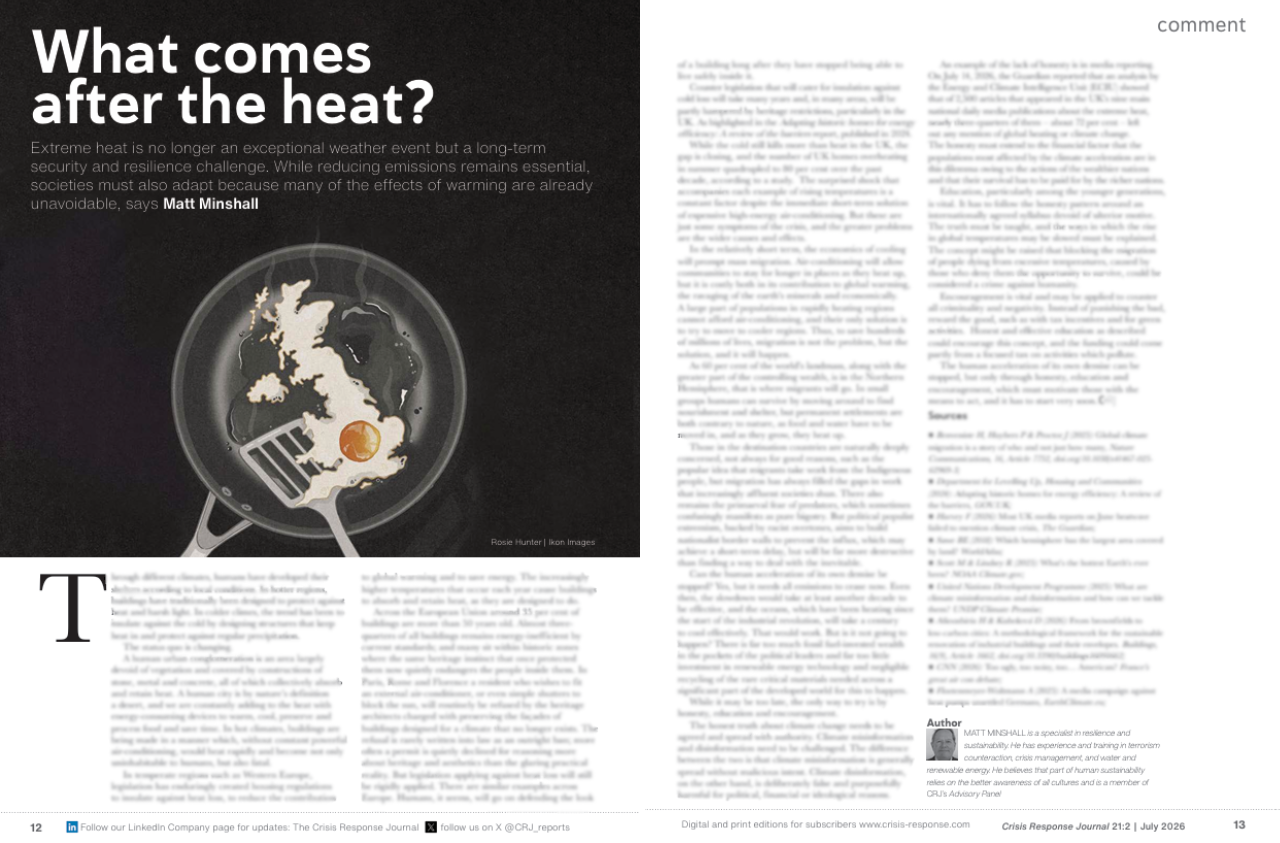
“Through different climates, humans have developed their shelters according to local conditions. The status quo is changing,” warns Matt Minshall (p 12)
She writes: “A crisis may begin when the final qualified technician retires, when the last compatible spare is installed, when the generator is no longer load-tested, when the service contract ends, when the substitute remains untried, or when local responders cease to recognise the equipment that protects a life or essential function.”
Beverley Griffiths explores what crisis fatigue means for organisational resilience. Flipping the coin, Christopher Blake notes the intersection between climate inequality and responder fatigue as a systemic resilience risk, and Gregory C Smith presents the concept of ‘moral injury’ in frontline responders after repeated exposure to catastrophic events.
“Indeed, one of the paradoxes of disaster work is that the very qualities that make someone an effective responder may also increase vulnerability to moral injury. People who care deeply, accept responsibility seriously, and remain committed to helping others are often the same individuals most likely to absorb the emotional and moral weight of repeated crises,” he writes.
Naveed Kapadia takes on the topic of fuel continuity for aviation after the US-Iran conflict. “Airlines are not managing crude oil in the abstract. They depend on a chain of refining, transport, storage, airport fuelling infrastructure, contractual supply, crew planning, aircraft positioning and schedule design. Pressure at any point can spread quickly across the network, raising costs, weakening route economics, and putting schedules under strain,” he says. Zainab Farooqui reports on anti-renewable rhetoric – both political and local – across the US and Europe and its implications for energy policy and climate targets.
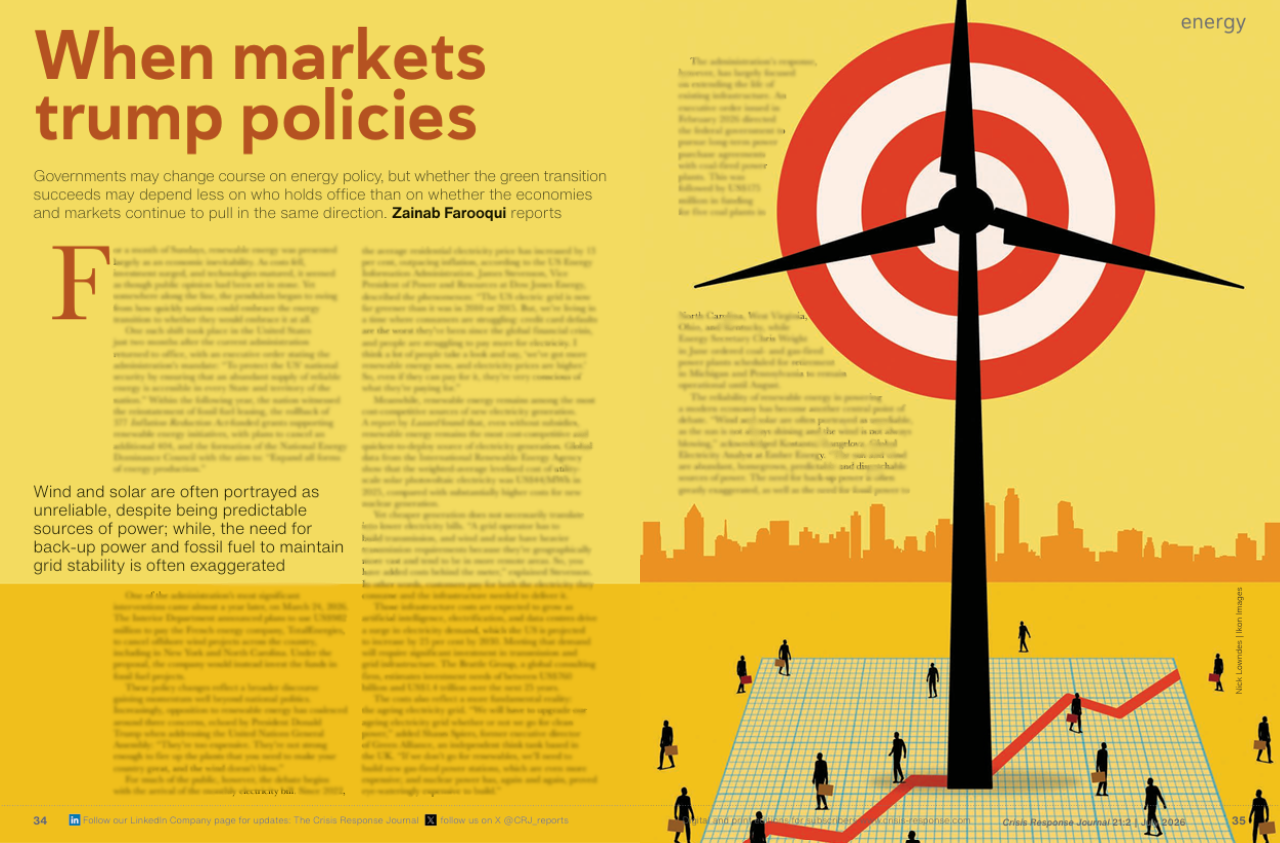
Zainab Farooqui explores the political narratives surrounding renewable energy, and what reality looks like on the ground (p 34)
Rod Cartwright shares key insights from his 2026 Reputation, Risk and Resilience report and what the findings means for risk and resilience professionals.
The need for a change in how we interact with current systems – both internationally and domestically – has never been as essential as it is now, according to our authors. Haseeb Md Irfanullah presents an approach for countries from the Global South to mobilise domestic climate funding in light of aid cuts. Gareth Byatt, Ilan Kelman and Ana Prados argue that the right mindset and investments can be key to avoiding disasters.
Gill Kernick reviews the updated edition of her book, Catastrophe and Systemic Change, which emphasises the need to move beyond lessons learned from past hazards towards systemic change, while Harry Mead looks at the implementation of a resilient security culture beyond Martyn’s Law in the UK. Max Colbert addresses the UK Metropolitan Police’s national rollout of facial recognition technology and its implications for civil liberties.
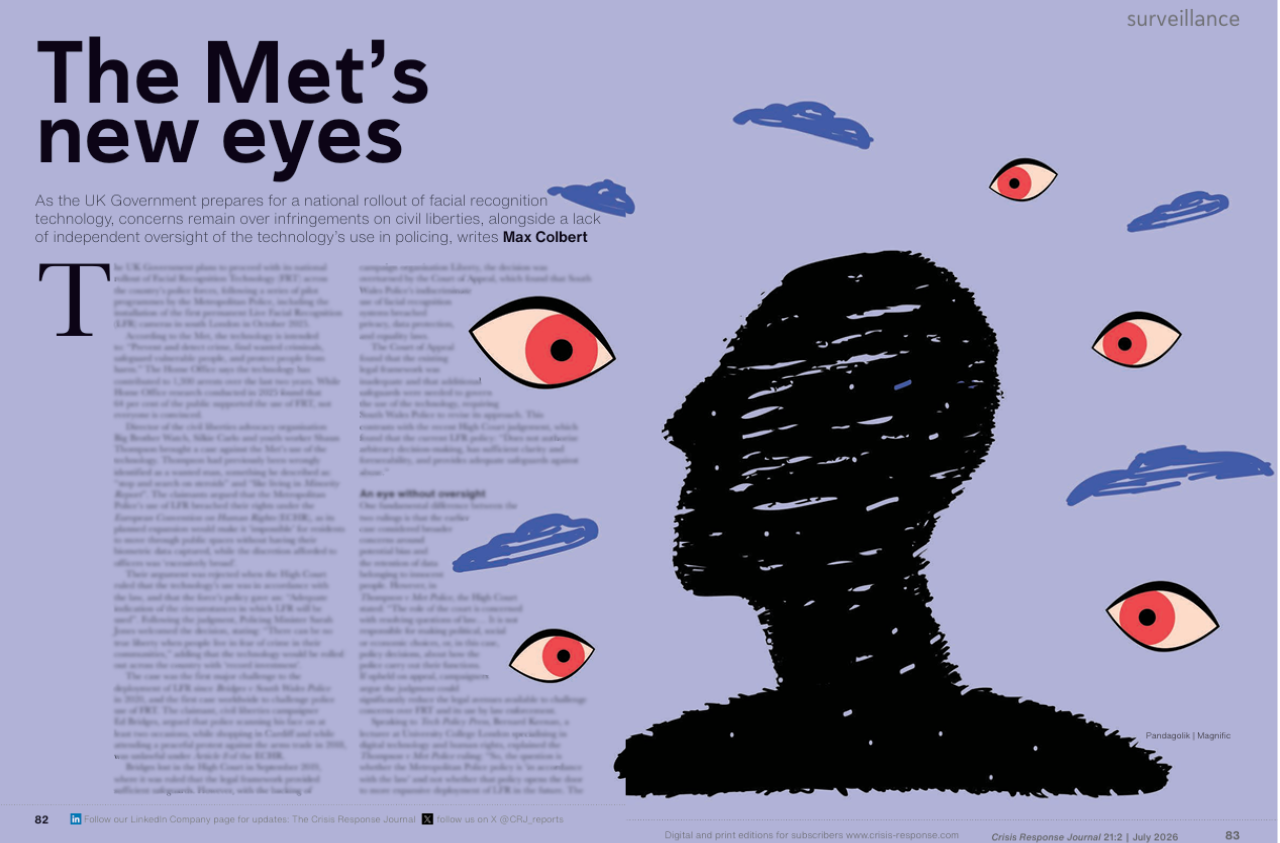
“As police forces continue expanding their use of FRT, critics argue that, without statutory limits and independent oversight, the risk of misidentification remains,” says Max Colbert (p 82)
On preparedness, Erik de Soir examines the current European state of strengthening civil preparedness, whether it be through public education or emergency plans. Jasmine Jobber takes a look at community-level child-centred disaster response in Bangladesh, and Robert McAlister draws lessons from Ukraine’s resilience for training programmes amid a decade of disruption. Zainab Farooqui speaks to the National Fire Agency team, Taiwan, on their disaster preparedness app that aids in cutting through the noise during natural hazards.
The edition sheds light on some innovative approaches to handling risk. Amy Leete introduces the applications of quantum computing for complex problem-solving, while John Oliver urges leaders to adopt a corporate trauma lens to identify crises and cultural adaptations hindering organisational performance.
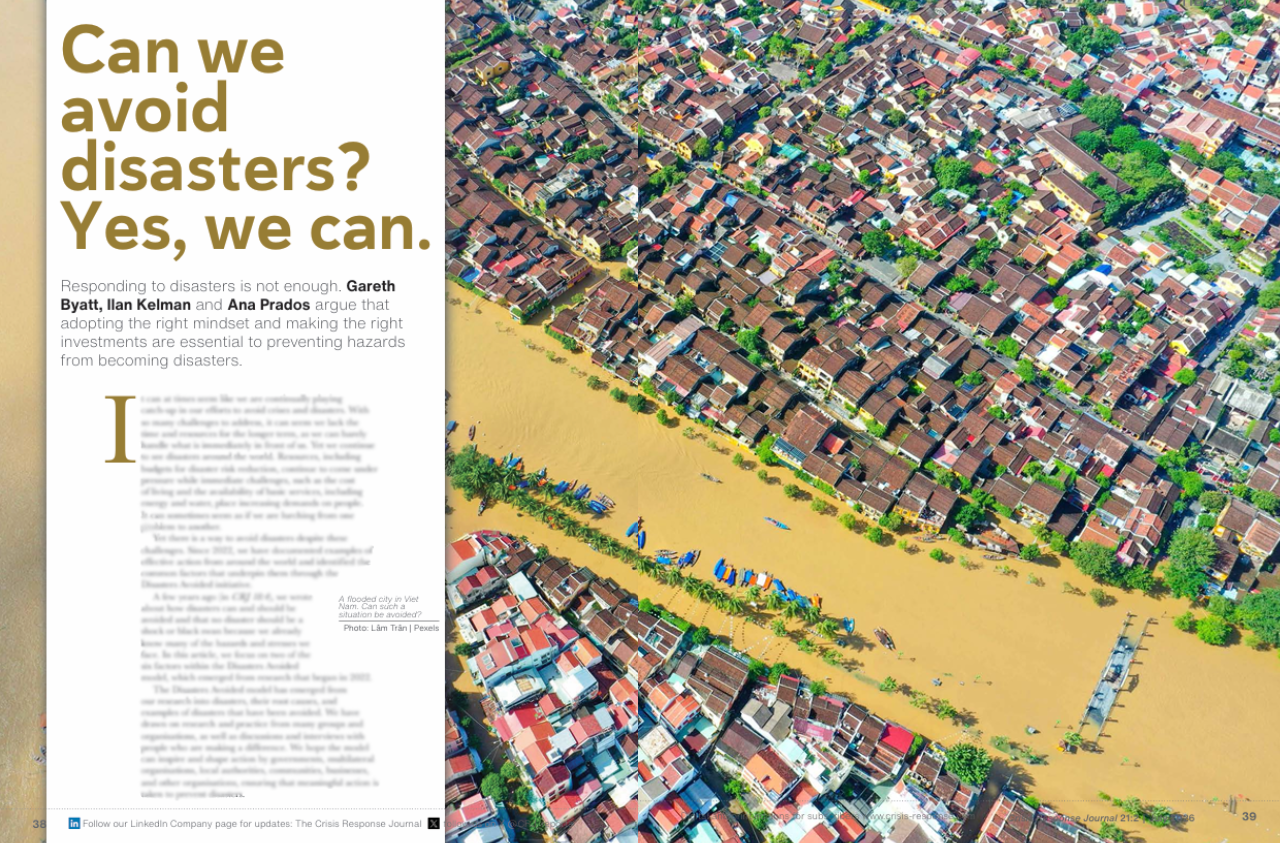
Gareth Byatt, Ilan Kelman and Ana Prados take on the question of whether we can avoid disasters with the right model – or not (p 38)
Erik de Soir presents approaches on how newsrooms can support journalists reporting from conflict. “Journalists are used to telling other people's difficult stories but often struggle to speak about their own vulnerability. In newsroom cultures where toughness, speed and availability are rewarded, it is not easy to admit: ‘I am not doing well.’ In the end, the question is not only how journalists can leave safely. It is also how they can return healthy, reconnect with ordinary life,” he adds.
Sean Cunningham introduces a decision-making model to improve trust between crisis chairs and teams. Noureddine Idrissi proposes redefining crisis communication as a strategic mechanism for organisational resilience, moving beyond its traditional function of reactive image management.
Emily Hough’s review of Stuart Andrews and Patrick Duggan’s Performing New Orleans, Rethinking Resilience in Art and Everyday Life, explores the role of arts and culture alongside traditional approaches to resilience and emergency planning. She writes: “My feeling is that responses, while impeccably well-meaning, can come across as top-down, unfeeling, rigid and prescriptive, and are often enforced harshly and without understanding specific circumstances of individuals or communities. I would argue that there has to be room for joy, the unexpected, the spontaneous, laughter, and, yes, beauty in our regular interactions with the places we live in and visit.”
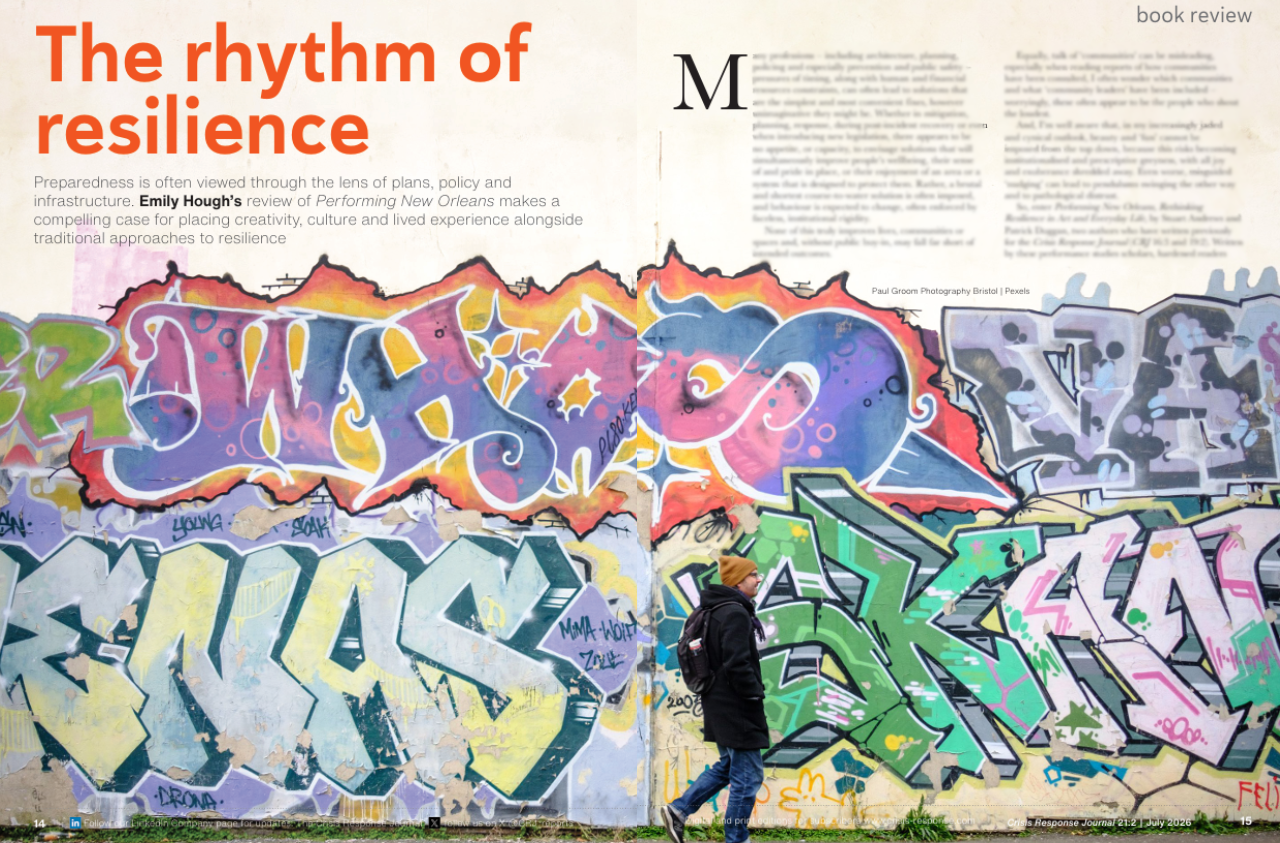
Emily Hough reviews Performing New Orleans, Rethinking Resilience in Art and Everyday Life, by Stuart Andrews and Patrick Duggan (p 14)
Florence Sharkey, Theresa Maynes, Martina Coyle, Pat Deeny and Dr Nigel Taylor look at the importance of disaster and community resilience simulations for final-year nursing and paramedic students.
Andrew Brown highlights the importance of hostage negotiation training and intelligence-led preparation for conservation rangers in the Niassa Special Reserve, Mozambique, amid attacks by armed groups. “Conservation rangers and scouts play a vital role in managing ecosystems, combating illegal activities and supporting local communities. The increasing militarisation training of their role can create additional complications, as they are not incorporated into armed forces or recognised as combatants. Most are classified as civilians under international law and therefore lack the protections afforded to combatants,” he says.
Frontline: Zainab Farooqui speaks to Robert Field about his journey tracking infernos across Southeast Asia to create a fire danger rating system.
On October 6 – 7, 2026, at Church House Westminster in London, UK, the Resilience World Nexus Summit will bring together C-suite leaders, resilience professionals and policymakers to explore how resilience is becoming more closely integrated with organisational strategy. Register here!
The Crisis Response Journal is available to subscribers only – we have a range of subscription rates to suit all needs. Click here for more details, or contact us at hello@crisis-response.com – we would love to hear from you!
Read CRJ 21:2 here!